The language we proposed also raised question about whether your photos can be part of an advertisement. We do not have plans for anything like this and because of that we’re going to remove the language that raised the question.
A collection of poignant shots from the Occupy movement, taken with an iPhone or other smartphone cameras: front-line views on an event that is not getting the coverage it deserves in mainstream media.
Thanks to the technological advancements of the last 15 years, including the development of image sensors capable of taking photos in low-light conditions, camera phones have become more and more important as tools that can turn each of us into a reporter. With the right apps, a current generation smartphone like the iPhone becomes a portable media center — you can take, process, and publish your photos on the spot in a few minutes. These devices become source of first-hand testimony on events that are either ignored or misrepresented by mainstream media sources. The wave of protests against the political and financial elites that is spreading throughout the globe are a prime example of this.
The Occupy Wall Street movement “officially” started on Semptember 17th, 2011 in Zuccotti Park, a publicly accessible park in Lower Manhattan, New York City. The protestors, coming from the most heterogeneous walks of life, grouped around a slogan, “We are the 99%”, which refers to the difference in wealth in the U.S. between the wealthiest 1% and the rest of the population. And wealth, in capitalistic societies, translates directly into political power — thus, those that should reform the society are the same that are benefiting from the unequal distribution of wealth. The wealthy own the media, the flow of information, and they shape the destiny of a nation using their money.
The new iPhone 4S announced today by Apple will include an upgraded camera, as we had previously speculated. As a matter of fact, the camera was one of the main points during Apple’s keynote, showing the importance of photography on smartphones also from a marketing point of view.
The new iPhone 4S announced today by Apple will include an upgraded camera, as we had previously speculated. As a matter of fact, the camera was one of the main points during Apple’s keynote, showing the importance of photography on smartphones also from a marketing point of view.
In one of the most awaited keynotes in the history of the iOS platform, Apple unveiled today their next iPhone, the iPhone 4S. The keynote was held in Apple’s Town Hall room, where the first iPod was launched 10 years ago. Tim Cook, CEO of Apple after Steve Jobs resigned this August, led the show passionately.
In one of the most awaited keynotes in the history of the iOS platform, Apple unveiled today their next iPhone, the iPhone 4S. The keynote was held in Apple’s Town Hall room, where the first iPod was launched 10 years ago. Tim Cook, CEO of Apple after Steve Jobs resigned this August, led the show passionately, and was joined on stage by other Apple representatives. Phil Schiller, Apple’s marketing director, had the task to announce the iPhone 4S.
Tim Cook leading the show
While a lot of fans that were eagerly waiting for an iPhone 5 announcement are already voicing their dissatisfaction though social networks and on technology blogs, the iPhone 4S includes the hardware enhancements that most were expecting. And the best news for iPhone photographers is that improvements to the camera made up a consistent part of the iPhone 4S announcement.
On the outside, the iPhone 4S looks exactly like its predecessor; anyhow, all the interior components had a consistent upgrade. The main features of the new iPhone include:
– New A5 processor: same chip currently used in the iPad 2. The new iPhone should be 7 times faster than the iPhone 4 at rendering graphics, according to Apple and representatives of Epic Games, on stage to show the demo of their new game, Infinity Blade 2.
– 8MP Camera with improved optics: 5 lenses instead of 4, improved light sensitivity, ability to shoot 1080p videos, faster sensor, which coupled with the new processor should make photography and video processing apps considerably faster. We will have a separate article today with more discussion on the camera improvements.
– Siri: voice based assistant, which will allow users to interact with their iPhone only using their voice. While this might seem a software only feature, it will be available only to iPhone 4S.
– New dual antenna system: the new antenna system will improve reception and allows Apple to manufacture a universal version of their iPhone able to connect to both CDMA- and GSM-based networks.
– iOS 5 and iCloud service: both available on October 12. iOS 5 will include a new camera app version and new software from Apple.
iPhone 4S: Price and Availability
The iPhone 4S will first launch in the U.S. and in 7 more countries (Canada, Australia, United Kingdom, France, Germany, and Japan) on October 14th. Apple will start accepting preorders on October 7th.
The price of the iPhone 4s in the U.S. will be $199 for the 16GB model, $299 for the 32GB model, and $399 for the 64GB model. We could not find a list of prices for all models outside the U.S., but so far we know that prices for the phone without subscription will be £499.00 for the base model in the U.K., and 629€ in Germany and France (and I suppose in most of Europe, even though the price is not showing up in other stores yet).
Phil Schiller introducing the iPhone 4S
On October 22nd, the iPhone 4S will become available in 22 more countries (Austria, Belgium, Czech Republic, Denmark, Estonia, Finland, Hungary, Ireland, Italy, Latvia, Liechtenstein, Lithuania, Luxembourg, Mexico, Netherlands, Norway, Singapore, Slovakia, Slovenia, Spain, Sweden, and Switzerland).
By the end of the year, the iPhone 4S will be available in over 70 countries.
iPhone 4 and iPhone 3GS Prices
Both models will be available and will support the new iOS 5 features (with the exception of the Siri system). In the U.S. the iPhone 4 8GB will cost $99 with a phone subscription; the iPhone 3GS will be free with an AT&T subscription.
Stay tuned for a couple more articles: one highlighting the new camera features, the other discussing iOS 5.
A photo uploaded on Flickr, supposedly taken by an Apple engineer at Cupertino, could be the first “leaked” image taken with an iPhone 5. Pocketnow.com, a website focusing on smartphones, discovered the photo while browsing Flickr looking for images taken with the new iPhone 5. ArsTechnica also commented on the find, considering the leak plausible enough.
The leaked photo, supposedly taken with an iPhone 5 prototype
According to the GPS data contained in the photo (which, of course, could also be forged) and the info on the Flickr profile, the photo was uploaded by an engineer at Cupertino this July, during lunch. Soon after the news about the leaked photo started spreading, the guy removed the photo from public viewing.
While the EXIF of the photo lists the camera as an iPhone 4, the pixel dimensions of the photo (2291 x 2235) don’t match those of the current iPhone 4 (2592 x 1936). According to the EXIF data, the photo was also cropped from an original resolution of 3264 x 2448 pixels, or 8MP.
Other interesting data in the EXIF include:
Maximum aperture: f/2.4 (current iPhone 4 maximum aperture is f/2.8)
Focal length:4.28mm (current iPhone 4 focal length is 3.85mm)
ArsTechnica goes on with an analysis of the EXIF and a comparison with photos taken with current generation smartphones equipped with 8MP sensors, concluding that that new iPhone might offer little improvements over the current iPhone 4 camera, especially in terms of noise reduction.
Whether this leak is an hoax or not, the iPhone 5 is expected to launch in the next months, possibly as early as October. In fact, while details on the device are scarce, according to the latest reports, suppliers are already manufacturing the iPhone 5 components at full speed, with 150,000 units being assembled each day.
This fall will also see the release of iOS 5, which will be compatible also with current generation iPhone 4 and iPhone 3GS.
As we already wrote in a previous news today, the developers of Hipstamatic have now added an option to delete your photos from public albums.
I think it is still important to remind our readers that everything we wrote in previous posts about the Creative Commons license applied to your photos on Hipstamatic Family Albums and the general rights Hipstamatic has on your photos once you have used their online services is still valid. So, deleting your photos from the Family Albums will not remove the Creative Commons license from them – which means that if somebody downloaded your photos, they can use them freely for as long as they want – and it will not remove the rights you gave Hipstamatic on your photos once you have used their online services – rights of using your photos in any way they want, including reselling them to third parties.
While many advocates of the “free for all” Internet consider Creative Commons the only way to go for sharing of information on the Internet, you must always be careful when deciding to go this route with your photos. And you must always remember that the Creative Commons license does not overwrite the rights you gave to a company when you accepted their Terms of Service.
I know – a lot of users just want to have fun with their iPhone and do not really care about who is using their photos. But there is a substantial number of users, also according to the number of e-mails and comments we had on the topic, that do care and that should thus always read the small notes in the Terms of Service of the apps they are using.
And if you are interested in different ways of sharing your photos, somebody is working on them – read our post about OpenPhoto – and even Flickr and Google+ have much more relaxed Terms of Service when it comes to photo sharing.
I have already said something about the way the developers of Hipstamatic handled their new Terms Of Services — and in the end their users — in a previous post, “Hipstamatic: Why Companies Can’t Be Your Friend”. For those that do not have time to read, the answer to the question is that these people are there just for the money. There is nothing wrong with it, but their promise of being your friends (almost hippie friends, judging from their Facebook posts) is contradicted by the way they write their Terms of Service. In brief, those using Hipstamatic public services accept to give away ownership of their photos to Hipstamatic, which can also resell them to third parties if they want to. And no, this is not a necessity: Flickr and Google+ both have licenses that do not allow them to resell your stuff to others. The reason why a lot of young companies opt for Terms of Service that are so empowering for them is that they give them less reason to fear legal issues with their user base, and they give them property over enormous amounts of assets: owning millions of photos can boost the value of your company enormously, especially if image search engines will get smarter as many expect over the next years.
The way the new “Family” Album feature in Hipstamatic was released, in my eyes, just confirms Hipstamatic’s way of doing business. Since the release of the feature, a lot of users have asked us how to delete photos in public albums. These users even tried asking Hipstamatic’s customer service, and the poor guy answering them said he can just collect the feedback and give no answers for the time being. Currently, there is no delete feature in Hipstamatic to allow deletion of photos in public albums (edit: the option was finally added, but the rest of this article still applies 100%). You can delete a photo locally, but you cannot remove it from the album “on the air”. And even if Hipstamatic decided to give you this feature, remember that your photos will forever remain in the public domain. So, if somebody downloaded a copy of it, or grabbed a screenshot of it, they are free to use it however they want.
When you share a photo using Hipstmatic’s Family Albums, you have a choice between two different Creative Commons licenses for your photo. Well, a few points must be made clear for you:
Once you have released something with a Creative Commons license, the license cannot be revoked, ever. Flickr allows you to change the license on your photos after you have released them as Creative Commons (but Flickr offers you also licenses where you always remain the only owner of your photos), but theoretically that is not legally acceptable. From the official website of the Creative Commons organization (you can find the FAQ here):
What if I change my mind?
Creative Commons licenses are non-revocable. This means that you cannot stop someone, who has obtained your work under a Creative Commons license, from using the work according to that license. You can stop distributing your work under a Creative Commons license at any time you wish; but this will not withdraw any copies of your work that already exist under a Creative Commons license from circulation, be they verbatim copies, copies included in collective works and/or adaptations of your work. So you need to think carefully when choosing a Creative Commons license to make sure that you are happy for people to be using your work consistent with the terms of the license, even if you later stop distributing your work.
CC licenses come in different flavors. Hipstamatic, being your best hipster buddies, also select by default for you the most permissive Creative Commons license of the two they make available, the Standard License. This allows anybody to use your photos for whatever they want, including derivative works and commercial use as long as they give credits to the original author. According to the Creative Commons website, “This is the most accommodating of licenses offered. Recommended for maximum dissemination and use of licensed materials.”. The other license in Hipstamatic, the one NOT selected by default, is Attribution-NonCommercial-NoDerivs License, the most restrictive CC license, only “allowing others to download your works and share them with others as long as they credit you, but they can’t change them in any way or use them commercially”. So, if you want to make sure people do not make money off your photos or use them for their beautiful derivative works, you must manually select this second option in Hipstamatic when uploading your photo. But remember: in both cases the license cannot be legally revoked, ever.
Regardless of the CC license you select, the company behind Hipstamatic always keeps the rights on your photos, as outlined in their Terms of Service. Which basically gives Hipstamatic the permission to exploit your photos in any way or format, forever, and resell them to third parties.
In the end, remember that even if Hipstamatic implements the delete functionality for their “Family” Albums (kinda misleading name, as one of our readers pointed out) your photos will still keep the Creative Commons license you have selected.
During the WWDC 2011 keynote, among the new features of iOS 5, Apple unveiled some important improvements to the Camera and Photos apps, some of which should hopefully extend to iOS developers.
Camera App Improvements
First of all, in the Camera app included in iOS devices, the volume button will now double as a shutter button; many of you will remember that Camera+ was temporarily removed from the App Store because developers had included this feature as a great Easter egg, loved by all users of the app. Hopefully, the volume/shutter button will be accessible also to app developers – after all, they were the first to implement it.
Apple also addressed the concern many iPhone and iPod photographers have with the time it takes to access the camera from a device in locked status; for this reason, Camera will get a shortcut from the lock screen for quicker access. It would be great if this feature were accessible also to other photography apps, with users being able to map their favorites to the lock screen, but we have no information pointing to this. Other improvements to the Camera app will be support for pinch-to-zoom gestures, single-tap focus and exposure locks.
Photos App Improvements
Editing capabilities, as crop, rotate, enhance, and red-eye reduction, will be included in the Photos app. Users will be able to organize photos in albums, push photos to all iOS devices using Apple’s new iCloud service, and post them to Twitter’s new picture hosting service.
iOS 5 will be available this fall for iPhone 3GS and 4, the third and fourth-generation iPod touch, and all iPads. iOS developers are already able to download iOS 5 from the developer area, but an NDA agreement theoretically prohibits them from unveiling their experience with the new operating system.
Commenting is great, but forum discussion is another thing. For all photographers and app developers interested in going more in-depth with their discussions about iPhone photography, Appotography now has a new forum, which also includes a skin optimized for mobile phones, like the main website.
Photographers can introduce themselves and their work to the community; developers can post news about their creations and get feedback from their users.
The goal would be to create a pleasant environment where enthusiasts of app-based photography can share their ideas and creativity, helping also developers in creating better products.
Our forums will also be the preferred way to start contests and giveaways – so join (start) the discussion now! Developers might be interested in reading the announcement on top of all forums to get verified.
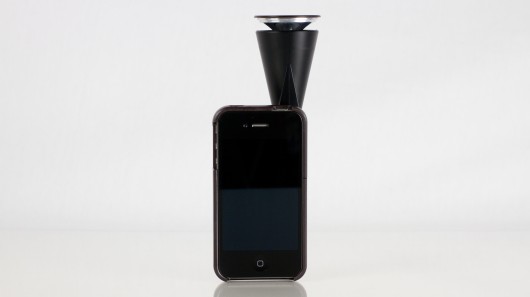
It is not a mystery that iPhone-related projects on KickStarter are always very popular. Anyhow, the success of GoPano Micro (KickStarter page here), a lens for iPhone 4 that will let users take panoramic videos at 360 degrees, is still remarkable. With less than 48 hours left to the end of the fundraising, more than 2500 backers have pledged to the project, for a grand total of nearly $160,000: 8 times the prefixed $20,000 goal.
KickStarter's fundraising has been a huge success for this special lens for iPhone 4
As usual for KickStarter projects, people pledging to the project will get some rewards; in this case, if you pledge $50 or more, you will be sent a GoPano Micro as soon as it becomes available, for less than the planned retail price of $80, according to EyeSee360, the company producing the lens and specialized in producing tools for panoramic imaging. The physical product must still be produced, so it will take a while before backers can get their hands on their lens.
As interesting and cool as the idea might seem, GoPano Micro has also its drawbacks. Once you have taken a video with your iPhone 4 equipped with the custom lens, the data must be uploaded to EyeSee360’s website for processing and sharing with the world through their 360-degree video player; a viewer app will also be available for iOS platforms. At this point, it is not clear if GoPano Micro will allow some export feature (for example, what if I want to extract a traditional single point of view video from the overall 360-degree video?). A video in the project’s page and following speculation seem to point to the fact that it will be possible to export the video in some player-independent format.
Another issue is obviously the final output resolution; since the 360-degree data must be compressed into the iPhone 4’s camera input, the single point of view video will be in lower resolution and quality than a normal video taken with an iPhone 4.
 Instagram has just published an article on their official blog to answer the concerns of users and press about their new TOS – and possibly to stop the movement of people that have been running away from their platform in the past 24 hours. Parts of the TOS will be reworded to be more clear and others will be removed entirely from the TOS. In particular,